
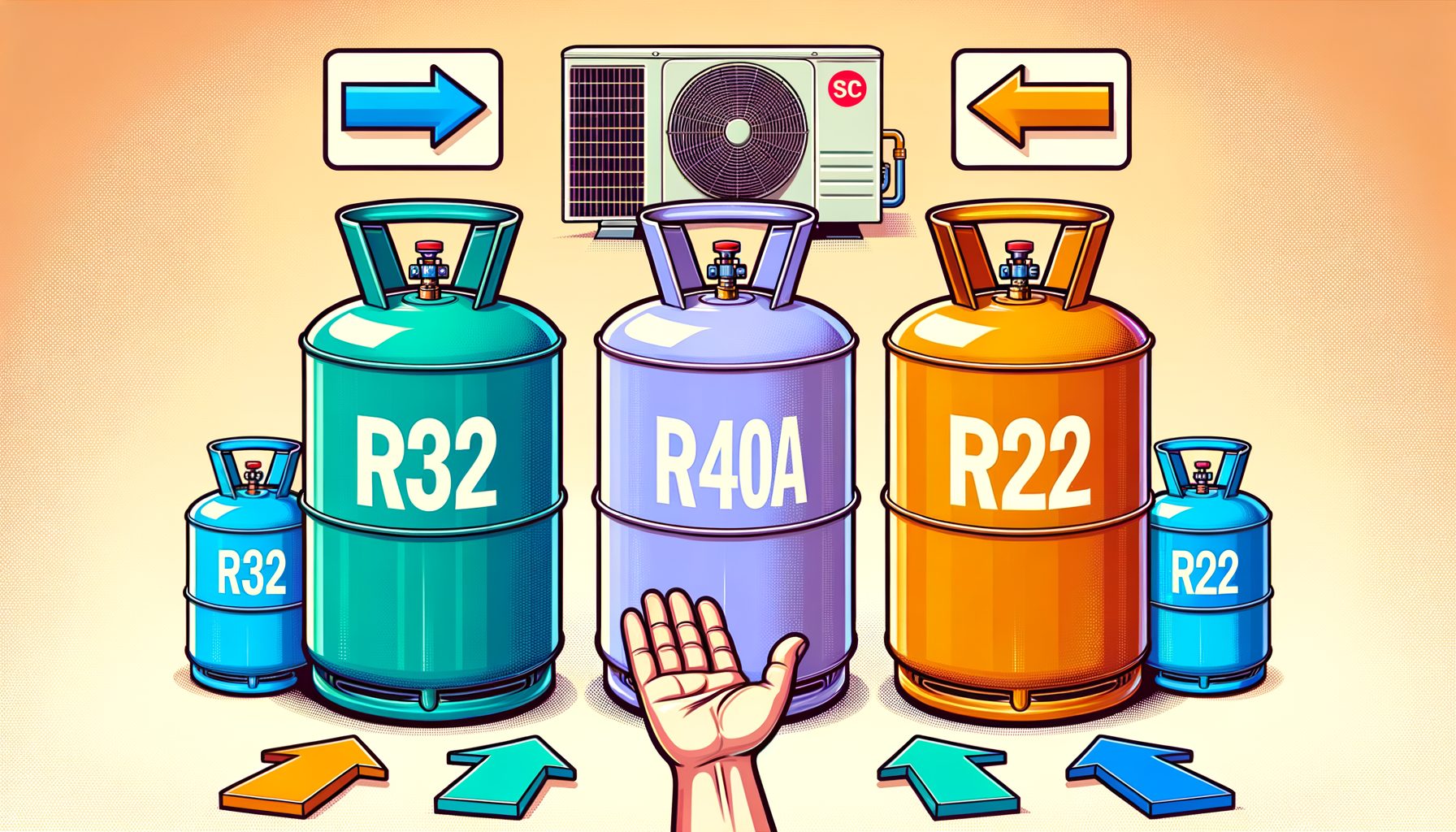
Shopping for or servicing an air conditioner can feel confusing today. The industry sits mid-transition to new refrigerants, and the stakes are real: your choice affects energy bills, maintenance costs, regulations, and climate impact. If you’re comparing R32 vs R410A vs R22, you’re already asking the right question. In the pages below, you’ll see what truly matters, we’ll cut through the jargon, and you’ll walk away with a clear path to the best refrigerant for your AC—wherever you live.
The real problem: choosing an AC during a global refrigerant transition
Buyer attention tends to fixate on size (tonnage) and star ratings. Yet the refrigerant inside your AC quietly dictates efficiency, repair costs, and whether your unit will remain legal and serviceable in the years ahead. Across markets, rules under the Montreal Protocol and its Kigali Amendment are phasing out older, ozone-depleting and high global-warming refrigerants. As a result, some models on shelves today are already on a countdown to phase-down, while others are touted as the more “future-proof” choice.
Well, here it is in simple terms:
– R22 is an HCFC (contains chlorine), harms the ozone layer, and is phased out in most countries for new equipment. Servicing existing R22 units is becoming harder and more expensive.
– R410A has no ozone impact but a high global warming potential (GWP). It dominated the last decade, yet many regions are phasing it down under climate rules.
– R32 is a newer, lower-GWP option that often delivers better efficiency with a smaller charge. It is mildly flammable (A2L), so proper installation and code compliance are required, and it’s widely adopted for residential split and window units.
For homeowners and small businesses, a misstep can lock you into higher energy bills, scarce refrigerant for repairs, or compliance headaches. Live in a hot climate? Pay attention to how well a refrigerant maintains capacity at high ambient temperatures—comfort and summer electricity use depend on it.
Bottom line up front: don’t treat the refrigerant as a footnote. Treat it as a foundational decision that shapes cost, carbon footprint, and lifespan.
Key differences: efficiency, safety, climate, and rules (with quick data)
To choose among R32, R410A, and R22, compare a few technical and regulatory markers. They drive efficiency, safe installation/maintenance, long-term legal status, and total ownership cost. Below is a concise snapshot. Values are typical or widely cited; actual performance depends on system design and test standards.
| Property | R32 | R410A | R22 |
|---|---|---|---|
| Ozone Depletion Potential (ODP) | 0 | 0 | ~0.055 |
| Global Warming Potential (100-year) | ~675–677 | ~2088 | ~1760–1810 |
| ASHRAE Safety Class | A2L (mildly flammable) | A1 (non-flammable) | A1 (non-flammable) |
| Typical Efficiency Trend in Modern ACs | Up to ~5–10% higher vs R410A | Baseline | Often lower in legacy systems |
| Operating Pressures | Similar to or slightly higher than R410A | High | Lower than R410A |
| Typical Refrigerant Charge (for same capacity) | ~20–30% less than R410A | Baseline | Varies by older designs |
| Regulatory Status | Widely accepted for new units; subject to safe-use codes | Being phased down due to high GWP | Phased out for new equipment; servicing restricted |
What do these numbers mean for you?
– Efficiency and bills: Inverter R32 models often post a modest but meaningful edge—many reports show up to about 5–10% better efficiency than comparable R410A units. Over several summers, that trims electricity costs and emissions.
– Climate and compliance: R22 damages ozone and is no longer sold for new systems in most regions. R410A carries a high GWP, so production and imports are being phased down under the Kigali Amendment and local laws. With much lower GWP and no ozone impact, R32 aligns better with future rules for residential ACs.
– Safety and service: R32’s A2L rating signals mild flammability. Sounds serious, yet reputable manufacturers build in safeguards, and many countries now permit A2Ls with defined rules (ventilation, charge limits, trained installers). R410A and R22 are A1 (non-flammable); that doesn’t make them “better,” just different to handle.
Then this: compatibility matters. You can’t simply put R32 into an R410A or R22 system. Oils, pressures, and safety requirements differ. R22 systems also can’t be converted to R410A without major component changes. While some “drop-in” blends exist for R22 service, they usually compromise performance and serve only as a stopgap.
Useful references to explore: ASHRAE 34 for refrigerant safety classes, IPCC assessments for GWPs, and national rules like the U.S. AIM Act or EU F-gas. See sources at the end.
When to choose R32, stick with R410A, or retire R22: practical scenarios
A straightforward way to decide follows, based on real-world situations across climates and regions.
Choose R32 if you’re buying a new split or window AC and your local code permits A2L refrigerants. You’ll likely get slightly better efficiency and a lower climate footprint. R32 units use less refrigerant mass for the same capacity, and many hold capacity better in high ambient temperatures—handy in hot zones. Ensure your installer is trained for A2Ls and follows instructions on piping, leak testing, ventilation, and electrical protection. For most new homes and small offices, R32 is the most future-aligned pick.
Keep a good R410A system if it’s relatively new, efficient, and leak-free. Even with phasedown underway, R410A will remain serviceable for years, and parts are widely available. If your unit is a quality inverter with solid seasonal efficiency, the greenest and cheapest path may be proper upkeep (clean filters and coils, correct charge, adequate airflow) rather than early replacement. Plan a swap when efficiency drops, repair costs rise, or local rules and refrigerant availability make service harder and pricier.
Retire R22 systems as a priority. R22 depletes ozone and is banned for new equipment in most countries. Recovered or recycled R22 is increasingly scarce and costly. If your R22 unit leaks or suffers a major component failure (compressor, coil), replacement is usually the rational move. “R22 drop-in” blends often cut performance and don’t fix long-term service hurdles. Upgrading to an R32 or other low-GWP unit brings a step change in efficiency and peace of mind on regulations.
Edge cases to consider:
– If your building code hasn’t yet adopted A2L refrigerants, you may be limited to R410A or other locally approved low-GWP options. Check with your installer and authority having jurisdiction.
– In very cold climates, consult performance maps. Both R32 and R410A heat pumps can be engineered for low-ambient operation, but regional product availability varies. For heating-dominant homes, look for cold-climate heat pumps rated for your lows.
– If you’re planning a remodel, factor in line-set routing and charge limits. Proper sizing and piping lengths matter for both efficiency and A2L safety compliance.
Bottom line: for a new AC, R32 is typically the smarter long-term pick where available and allowed. Keep a solid R410A unit if it’s performing well. Replace R22 units as soon as practical, especially if a repair involves refrigerant handling or expensive parts.
Total cost of ownership and energy math: a simple example
Let’s put quick numbers to it. Imagine a 1.5-ton (18,000 BTU/h) inverter split AC used for 1,800 cooling hours per year. We compare a modern R410A unit (SEER 16 equivalent) and a comparable R32 unit (SEER 17.5 equivalent). Your ratings may differ, but the order of magnitude will be similar.
– Annual cooling output = 18,000 BTU/h × 1,800 h = 32.4 million BTU
– R410A energy use = 32.4e6 BTU ÷ 16 (BTU/Wh) = 2.025e6 Wh = 2,025 kWh
– R32 energy use = 32.4e6 BTU ÷ 17.5 = 1.851e6 Wh = 1,851 kWh
– Annual savings ≈ 174 kWh
At an electricity price of $0.22/kWh, that’s about $38 per year. In a hotter climate (say, 2,400 hours), savings rise to roughly $50 per year. Over 10 years, expect about $380–$500 off your electricity bill, plus a smaller carbon footprint. If the R32 model is similarly priced—or only slightly more—total cost of ownership often favors R32.
Now look at an older R22 unit. Many R22 systems in the field are 10–20 years old with seasonal efficiency closer to SEER 10–13 (or local equivalents). Using the same 1,800-hour example with SEER 12:
– R22 energy use = 32.4e6 BTU ÷ 12 = 2.7e6 Wh = 2,700 kWh
Compared to the R32 unit at 1,851 kWh, the annual difference is about 849 kWh. At $0.22/kWh, that’s roughly $187 per year. Over 10 years, you could save about $1,870 on electricity alone—often enough to justify replacement even before factoring in costly R22 servicing.
Service and refrigerant costs matter, too:
– R22 is costly and scarce; topping up after a leak can cost several hundred dollars depending on location.
– R410A remains available but may face price and availability pressure as phasedowns progress.
– R32 is widely available for new residential systems and typically requires less charge mass, which can help reduce refrigerant cost per unit.
Real-world tip: energy ratings aren’t the whole story. Clean coils, correct charge, well-sealed ducts (for ducted systems), and proper sizing dramatically affect actual consumption. Partner with a licensed installer who performs a load calculation and follows manufacturer commissioning steps. That single step can save more energy than the nominal difference between two refrigerants.
Q&A: quick answers to common refrigerant questions
Q1: Can I retrofit my R410A AC to R32?
A: No. R32 has different properties and a different safety class (A2L). Components, oils, charge limits, and controls don’t match. If you want R32, choose a purpose-designed R32 unit.
Q2: Is R32 safe in homes?
A: Yes, when installed and serviced by trained professionals under applicable A2L codes and manufacturer instructions. Millions of residential R32 units operate safely worldwide. Proper ventilation, leak testing, and electrical protection are key.
Q3: Should I replace a working R410A unit just to get R32?
A: Usually no. If your R410A unit is efficient and in good condition, run it until major repairs arise. Plan for a low-GWP replacement when the time comes.
Q4: What can I do if I still have an R22 system?
A: If it’s small and has a leak or major fault, replacement is typically the smartest move. If it’s running and leak-free, plan for replacement soon. Avoid large R22 recharge costs unless you must bridge a short period.
Helpful resources and regulations:
– U.S. EPA AIM Act and HFC phasedown: https://www.epa.gov/climate-hfcs-reduction
– EU F-gas regulation overview: https://climate.ec.europa.eu/eu-action/fluorinated-greenhouse-gases-eu/overview_en
– UNEP Montreal Protocol and Kigali Amendment: https://ozone.unep.org
– ASHRAE Standard 34 (safety classification): https://www.ashrae.org/technical-resources/standards-and-guidelines
– IPCC GWPs and climate science: https://www.ipcc.ch
– Daikin technical notes on R32 adoption: https://www.daikin.com
Conclusion: your clear path to the best refrigerant choice
Here’s the bottom line. Among R32 vs R410A vs R22, the differences will shape your comfort, wallet, and environmental impact for years. R22 belongs to the past—ozone-depleting, phased out for new equipment, and expensive to service. R410A defines today’s mainstream but is being phased down due to high GWP. R32, by contrast, is the forward-leaning option for many residential ACs: lower GWP, often better efficiency, smaller charge, and broad manufacturer support—provided local codes allow A2L refrigerants and your installer is qualified.
If you’re buying new, R32 usually offers the best mix of performance, future compliance, and lower climate impact. If you already own a solid R410A unit, keep it well maintained and plan your next upgrade thoughtfully. Still running R22? Make replacement a priority to avoid rising service costs and compliance risks.
Take action now: check your current unit’s nameplate to confirm the refrigerant, review your local rules (EPA AIM Act in the U.S., EU F-gas in Europe, or your national authority), and get quotes for an R32 system from licensed installers familiar with A2L safety. Ask for a proper load calculation, efficiency ratings (SEER/SCOP or local equivalents), and a commissioning checklist. A well-specified, well-installed R32 AC can cut energy use, shrink carbon impact, and keep you comfortable for a decade or more.
The transition can feel complex, yet the path is clear: choose a refrigerant that respects your budget today and the planet tomorrow. What’s interesting too, small informed steps compound into big savings. Ready to make the switch or map your upgrade plan? Start by checking your current refrigerant and calling one qualified installer to discuss R32 options.
Sources
– U.S. Environmental Protection Agency (EPA) – AIM Act: https://www.epa.gov/climate-hfcs-reduction
– European Commission – F-gas policy: https://climate.ec.europa.eu/eu-action/fluorinated-greenhouse-gases-eu/overview_en
– UNEP Ozone Secretariat – Montreal Protocol and Kigali Amendment: https://ozone.unep.org
– ASHRAE Standard 34 – Designation and Safety Classification of Refrigerants: https://www.ashrae.org/technical-resources/standards-and-guidelines
– IPCC Sixth Assessment materials (GWP references): https://www.ipcc.ch
– Daikin (R32 technical adoption notes for residential AC): https://www.daikin.com