
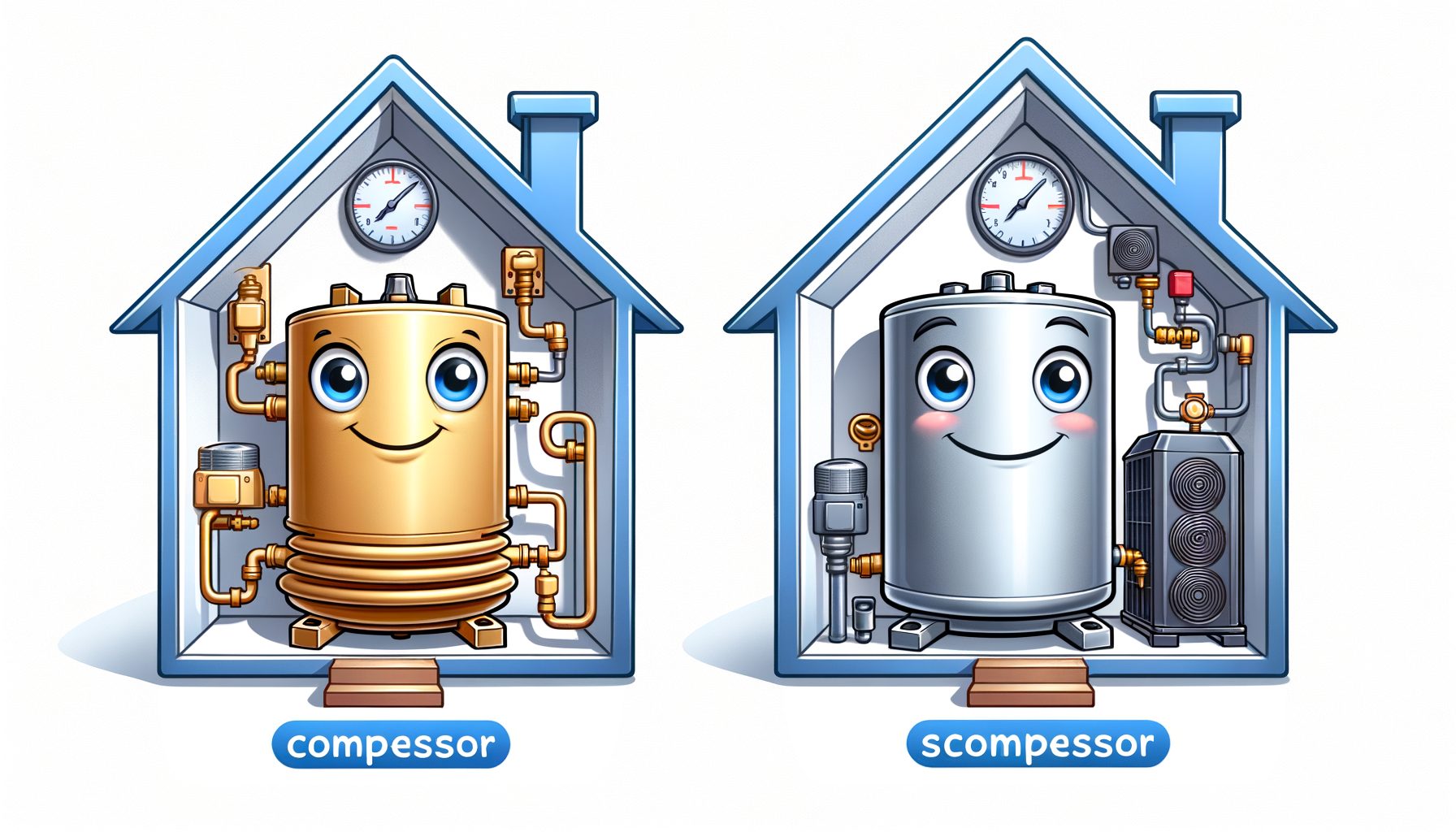
Choosing a new air conditioner—or weighing a replacement? The same debate keeps popping up: rotary vs scroll AC compressors. Which option truly fits your home, your climate, and your budget? At the center of it all sits the compressor, the “heart” of the system that shapes energy bills, noise, and reliability. In the pages ahead, expect a clear, practical answer that balances performance, cost, and comfort, helping you sidestep buyer’s remorse and enjoy steady, quiet cooling all season.
Many shoppers zero in on brand names and SEER ratings while overlooking the compressor type that dictates day-to-day comfort. Ever notice how two similar-looking units can feel different—one runs quieter, another cycles less, one sips less power in muggy weather? The compressor plays a major role. Keep reading to see how rotary and scroll designs operate, how they compare in real homes, and a smart way to decide which suits your setup.
How Rotary and Scroll Compressors Work—and Why That Matters for Comfort
Before picking a side in the rotary vs scroll debate, a quick mechanical tour helps. In a rotary compressor, a rolling piston turns inside a cylinder while a spring-loaded vane separates high and low pressure. As that piston spins, refrigerant gets compressed in a smooth, continuous sweep. Compact and cost-effective, rotary designs show up widely in smaller systems, including many mini-splits. Twin-rotary versions balance forces more evenly, trimming vibration and boosting efficiency—especially in inverter models that modulate speed.
A scroll compressor uses two scroll-shaped spirals—one fixed, one orbiting—to compress refrigerant toward the center. The design uses fewer moving parts, limits internal leakage, and often delivers superior efficiency in medium-to-large capacities (roughly 2–5 tons, or about 7–18 kW of cooling). Scroll compressors are common in central air systems and heat pumps and are well-known for smooth operation, solid durability, and strong performance across a range of loads.
Why does the internal design matter in your living room? First, it influences how steadily the system can match your cooling needs. Systems paired with inverter controls—common in both modern rotary (especially twin-rotary) and scroll units—can ramp speed up or down to maintain even temperatures, reduce on/off cycling, and cut energy use. Second, design affects noise and vibration. Scrolls are often praised for smooth, quiet operation at moderate capacities, while twin-rotary compressors have closed that gap significantly in modern mini-splits. Third, durability and tolerance to challenging conditions (like brief liquid refrigerant “floodback” at startup) tend to favor scrolls, though good system controls and installation practices help both types last.
Bottom line: both technologies can deliver excellent comfort today. Rotary compressors shine in compact, budget-friendly, and many inverter mini-split systems. Scroll compressors excel in many central AC and heat pump setups that prioritize steady efficiency and long-term reliability in larger capacities. Your best choice depends on system size, controls (inverter vs single-stage), and how you use your AC.
Efficiency, Noise, and Comfort: What You Feel and Pay For
When comparing rotary vs scroll AC compressors, three outcomes matter most: efficiency (what you pay on your utility bill), noise (what you hear indoors and outdoors), and comfort (steady temperature and humidity). Efficiency is usually measured at the system level (SEER2/SEER, EER, HSPF for heat pumps), not just the compressor. That means compressor type, inverter controls, coil design, and refrigerant all contribute to real-world performance.
In practice, scroll-based central systems often deliver strong mid-to-high seasonal efficiency, particularly with two-stage or variable-speed (inverter) designs. Rotary-based mini-splits, especially with twin-rotary compressors and advanced inverters, can reach top-tier efficiency as well—some of the world’s most efficient room ACs use twin-rotary designs. Noise-wise, scrolls and twin-rotary inverters are both quiet; fixed-speed rotaries tend to be louder at startup. Comfort-wise, inverter systems—regardless of compressor type—maintain more stable indoor temperatures and better dehumidification because they avoid frequent on/off cycles.
Here’s a quick, typical comparison (system-dependent; ranges vary by brand, size, and installation):
| Feature | Rotary (incl. twin-rotary) | Scroll |
|---|---|---|
| Typical Capacity Range | 0.75–3 tons (2.6–10.5 kW); common in mini-splits | 2–5 tons (7–18 kW); common in central AC/heat pumps |
| System Efficiency Potential | High with inverter; many mini-splits reach SEER 18–30 | High with 2-stage/variable speed; central systems SEER 16–24 |
| Noise (outdoor unit) | Approx. 50–65 dB with inverter; higher for fixed-speed | Approx. 50–65 dB with variable speed; smooth operation |
| Vibration | Low in twin-rotary; moderate in single-rotary | Low; inherently smooth orbiting motion |
| Durability/Tolerance | Good with proper controls; sensitive to liquid floodback | Very good; generally more tolerant to brief floodback |
| Installed Cost (typical) | Often lower for smaller systems/mini-splits | Often higher for larger central systems |
Data from public manufacturer literature and efficiency databases show that both compressor types can lead to excellent system ratings when paired with inverters and well-sized coils. What matters most is matching capacity and modulation to your home’s load. If you want quiet and efficient in a small apartment or single room, a twin-rotary inverter mini-split is often outstanding. For a whole-home central system in a larger house, variable-speed scroll systems are proven, quiet, and durable.
For deeper reading on ratings and selection, see ENERGY STAR guidance and seasonal performance resources from the U.S. Department of Energy: ENERGY STAR AC guidance and DOE Energy Saver: Central AC.
Which Is Better for Your Scenario? Climate, Home Size, and Usage Patterns
No single winner exists; the right choice depends on where you live, how big the space is, and how you cool it. In small to medium areas (studios, apartments, individual rooms), rotary-based inverter mini-splits excel. They ramp down to very low speeds, maintain steady temperatures, and are easy to install without duct losses. Many top-rated models use twin-rotary compressors that stay whisper-quiet and efficient—great for bedrooms or home offices.
For larger, ducted homes (especially 2–5 tons/7–18 kW), scroll-based central systems often provide a strong balance of durability and comfort. Variable-speed scroll systems keep temperatures even across multiple rooms, handle humidity well, and reduce short cycling. If you live in a hot, humid climate, prioritizing dehumidification is key; variable-speed systems (scroll or twin-rotary) that can run longer at low speed are your friend.
Cold-climate heat pump users should look closely at low-ambient performance. Many premium scroll and twin-rotary inverter units are engineered for heating in sub-freezing conditions. Check extended performance data, not just the nominal rating. If you plan to heat and cool with one system year-round, invest in a variable-speed design with verified low-temperature capacity and defrost strategies—an attribute that matters more than the compressor label alone.
Usage patterns count, too. If you run AC for short bursts, a properly sized inverter system avoids constant on/off cycles that waste energy and wear parts. If you keep the system on for long periods, modulation will also pay off by matching load and cutting peaks. For off-grid or solar-heavy homes, soft-start inverters (common with both twin-rotary and scroll) reduce startup surges and play nicely with inverters and batteries.
One more consideration: service access and local support. In some regions, technicians have more experience and parts inventory for scroll compressor central systems; in others, rotary mini-splits dominate with strong dealer networks. Availability affects repair times and costs. Ask local pros about parts, lead times, and warranty service trends for the specific models you’re considering.
Cost, Maintenance, and Reliability Over Time
Total cost of ownership (TCO) goes beyond the price tag. It includes installation, energy over 10–15 years, maintenance, and repairs. Rotary-based mini-splits are often cheaper to purchase and install per room. They can deliver standout efficiency for targeted spaces, saving energy by cooling only where you need it. Scroll-based central systems may cost more upfront but can cover the whole home with balanced comfort—important if you have multiple floors or many rooms.
Maintenance influences reliability. Both compressor types depend on clean airflow (filters, coils) and correct refrigerant charge. Rotaries can be more sensitive to liquid refrigerant returning to the compressor (floodback), which stresses components. Careful installation, correct line set lengths, and smart controls mitigate this risk. Scroll compressors are generally more tolerant to brief floodback and have fewer moving parts, which can translate into strong longevity—especially in well-installed, properly sized systems.
Contractor reports and manufacturer documentation consistently show that most premature compressor failures aren’t about the core design—they stem from installation mistakes (improper evacuation, moisture contamination, incorrect charge), poor airflow (dirty filters, undersized ducts), and mismatched components. Choose a qualified installer, insist on documented vacuum levels and weigh-in charging, and verify airflow specs. Those steps reduce risk regardless of rotary or scroll.
On energy costs, system controls deserve the focus. Variable-speed (inverter) systems can run at low capacity for long periods, cutting peaks and reducing total kWh. That’s where big savings come from. Many high-SEER mini-splits (often twin-rotary) and central systems (often scroll) deliver similar seasonal costs when sized and installed correctly. Warranty terms matter too—compare compressor warranties (often 5–10 years, sometimes longer with registration) and look for local service partners.
Refrigerants and sustainability should be part of the decision. Newer systems use lower-GWP refrigerants or are transitioning to them. In many markets, improved refrigerants plus inverter controls dramatically lower lifetime emissions and costs. Check local regulations and ask your installer about next-generation options. Resources: U.S. EPA SNAP: Refrigerants and ASHRAE Handbook.
FAQ: Rotary vs Scroll AC Compressors
Q1: Which is more efficient—rotary or scroll?
System efficiency depends on more than compressor type. Inverter control, coil design, and sizing dominate. Scroll compressors often shine in 2–5 ton central systems, while twin-rotary compressors in mini-splits can achieve top-tier SEER ratings. Choose variable speed if possible; that’s the biggest efficiency lever for most homes.
Q2: Which is quieter in real homes?
Both can be very quiet with inverter technology. Scrolls are smooth and low-vibration in many central systems. Twin-rotary mini-splits are exceptionally quiet at low speeds, often ideal for bedrooms and studies. Fixed-speed rotaries tend to be louder at start/stop. If noise is critical, check published sound levels (dB) and ask to hear a running unit if you can.
Q3: Which lasts longer?
Longevity is tied more to installation quality, load matching, and maintenance than the label “rotary” or “scroll.” Scrolls have a reputation for durability and tolerance to brief floodback. Rotaries, especially twin-rotary with good controls, also last many years when installed and charged correctly. Prioritize a reputable brand, verified commissioning, and proper filtration.
Q4: What about cost and repairs?
Rotary-based mini-splits usually win on room-by-room cost. Scroll-based central systems may cost more upfront but deliver whole-home comfort. Repair costs vary by market and brand; availability of parts and local expertise matters. Ask for model-specific warranty terms and local service coverage before buying.
Q5: Inverter vs single-stage—how does that affect the decision?
It’s huge. Inverter systems (rotary or scroll) modulate output to match your home’s needs, improving comfort, efficiency, and noise. If your budget allows, choosing an inverter system typically delivers more benefit than choosing one compressor type over the other in a fixed-speed setup. See manufacturer resources like Daikin’s inverter overview and technical content from Copeland (scroll compressors).
Conclusion: A Smart Path to the Right Choice
We’ve covered what really separates rotary vs scroll AC compressors: how they work, what they mean for comfort and bills, and how to match them to your home. Rotary compressors—especially modern twin-rotary designs—are compact, quiet, and highly efficient in mini-splits and smaller systems. Scroll compressors are smooth, durable, and excellent in many central AC and heat pump systems, particularly at medium-to-large capacities. The key takeaway is that system design and inverter control often matter more than the compressor label alone.
If you want the shortest route to a great decision, follow this checklist: 1) Size your system properly—ask for a Manual J or equivalent load calculation; 2) Choose inverter/variable speed when possible for better comfort and efficiency; 3) Match technology to home type—twin-rotary inverter mini-split for single rooms or small apartments; variable-speed scroll for larger ducted homes; 4) Verify installation quality—documented vacuum to low microns, correct refrigerant charge, and airflow; 5) Compare warranties and local service networks for your exact model. These five steps will impact your experience more than a brand slogan or a single spec line.
Ready to move forward? Compare two or three proposals side by side. Ask each installer to specify compressor type, whether it’s inverter-driven, expected seasonal efficiency, sound ratings, and warranty. Use trusted references like ENERGY STAR and the DOE Energy Saver pages to validate claims. If you live in a region with cooling rebates, check your local utility for incentives that can offset the cost of higher-efficiency models.
The right choice keeps your space comfortable, your bills predictable, and your AC quietly in the background. With a clear view of how rotary and scroll compressors perform in the real world—and a focus on inverter control and proper installation—you can buy with confidence. Start your shortlist today, ask smarter questions, and enjoy a cooler, quieter home this season. If you could change just one thing about your current AC—noise, comfort, or cost—what would it be?
Sources and Further Reading
– ENERGY STAR: Air Conditioning — https://www.energystar.gov/products/heating_cooling/air_conditioning
– U.S. DOE Energy Saver: Central AC — https://www.energy.gov/energysaver/central-air-conditioning
– ASHRAE Handbook (Technical Resource) — https://www.ashrae.org/technical-resources/ashrae-handbook
– U.S. EPA SNAP: Refrigerants and Alternatives — https://www.epa.gov/snap/refrigerants
– Copeland Knowledge Center: Scroll Compressors — https://www.copeland.com/en-us/knowledge-center/scroll-compressors
– Daikin: Inverter Technology Overview — https://www.daikin.com/products/ac/inverter